You have lots of old tiles on your splashback/bathroom floor that are solidly in place. Your quote includes the removal of tile, and it’s no small amount. You may be thinking, can tiles be laid over tile and not have to be demolished?
Sometimes, yes. Depending on the type of tile preparation, tiling will save money, mess, and time over using new tiles when the tiles stay in place. If it’s attached to the wrong surface, it will die within a year or two, and its removal and reinstallation will be more expensive than its worth.
How a tiler makes his decision, what he looks for in a Melbourne house, and where it will become a prime example of a ‘sensible shortcut’ becoming a ‘false economy ‘.
Short answer: When the previous tiles are securely bonded, level, dry, and located in an area with little moisture, such as a kitchen splashback or hallway, then they will normally accept the new tiles. Don’t over any hollow or cracked tiles, or where they will be more than an inch or so above the ground. Before anyone else promises, all a tiler needs to do is test the surface to be sure there’s no problem.
Can You Tile Over Other Tiles?
Most of the answer comes down to what’s under the new tiles. As with anything else, new tiles will only be as secure as the surface to which they adhere.
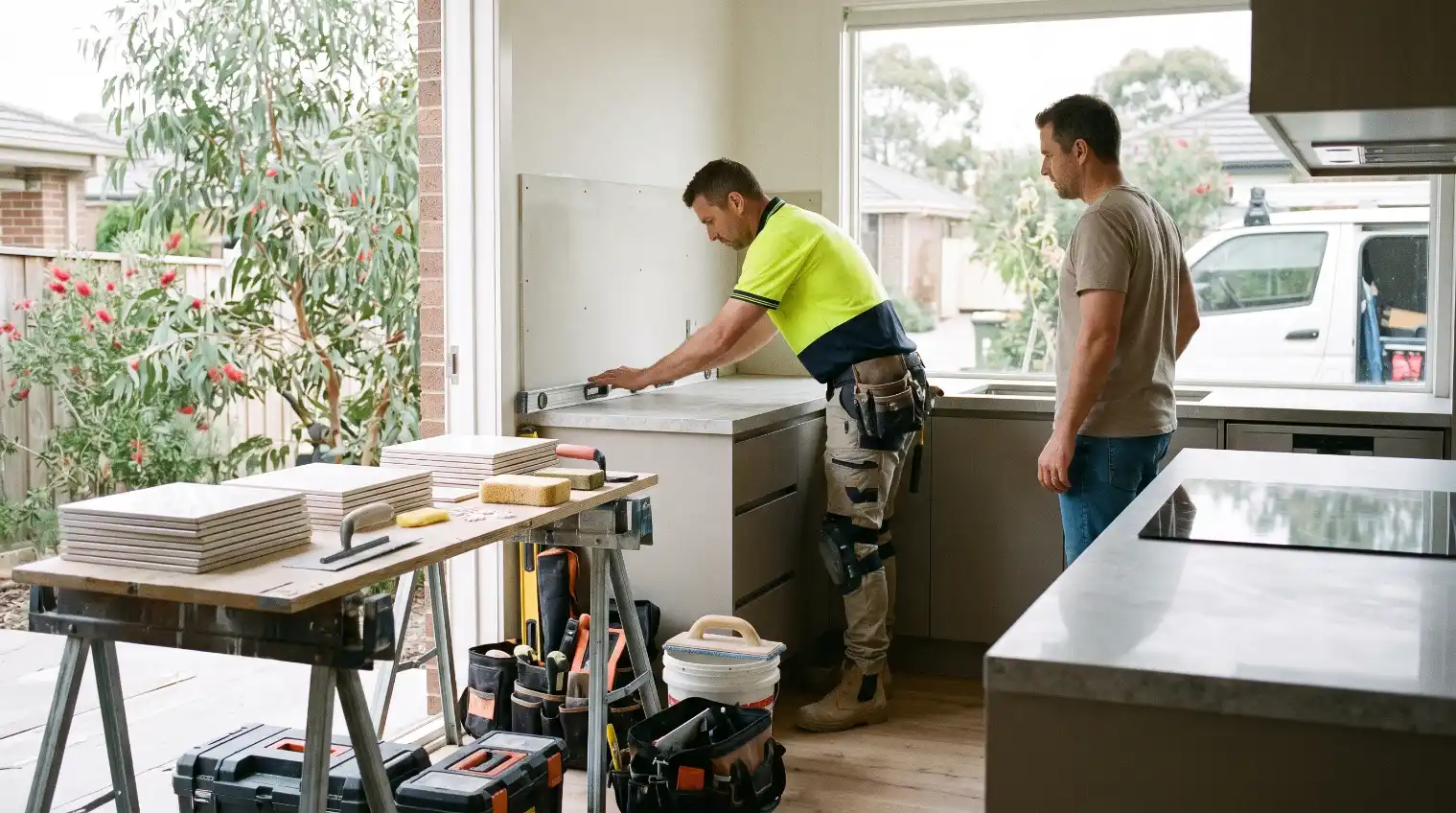
The following conditions are generally conducive to working with tile over tile:
- Tiles are securely joined. No hollow (when tapped) or rock moves.
- It has a plane surface. Requesting readjustment of lippage and dips through new tiles.
- No water damage. NO STAINING, Mould, swelling grout lines, or efflorescence.
- It’s an arid or low water content zone. Typical suspects are splash backs, feature walls, entries, and hallways.
- The additional space is available for the extra height. Doors, thresholds, and appliances clear
The truth in a wet space is that if a tiler cannot see or confirm the back layer in that space, remove the existing tiles. It is impossible to waterproof without an inspection.
If it’s best to remove old tile pieces
- Hollow-sounding, loose or cracked tiles
- Go anywhere you may see water, such as in showers, wet-room floors, or where you can’t be sure that there is waterproofing beneath the floor.
- Hiring a swimming pool tiler will require their own swimming pool substrate and swimming pool waterproofing, as it is applied to its specific swimming pools.
- Groups of 10 - 15 mm that could cause an extra step on floors where doors need to jam when installed.
- Areas that have potential for moisture in the sub-floor beneath them
Here’s to Tiles: This is What Happens Before the New Tiles Get Installed.
The most common reason an over tile job fails is due to skipped tile preparation. A good job would consist of the following:
- Tap test. All tiles are checked for soft or hollow spots. The gaps are filled and leveled with those tiles.
- Clean all with grime cleaner; degrease. Unlike glue, kitchen splashbacks will not hold grease and soap film.
- Flatness check. A straight edge indicates high points and low areas, requiring grinding or leveling.
- Surface treatment. Glazed tiles are non-porous, which in general will be keyed and/or primed with a tile bonding primer that is appropriate for the adhesive.
- The right adhesive. An adhesive suitable for the existing tile and new tile, and applied properly.
- Movement joints. Located where the floor/wall should move, not grouted solid.
Ceramic tile installation should be performed according to the appropriate Australian Standard for ceramic tile installation (AS 3958.1). An experienced Melbourne tiler will be familiar with it and work in line with it. Our tile installation Melbourne team works to it on every wall and floor.
The Height Problem Most People Miss
The addition of new tile over old tile will generally be about 10 to 15 mm thicker. That may seem small when it doesn’t cause any trouble until it does:
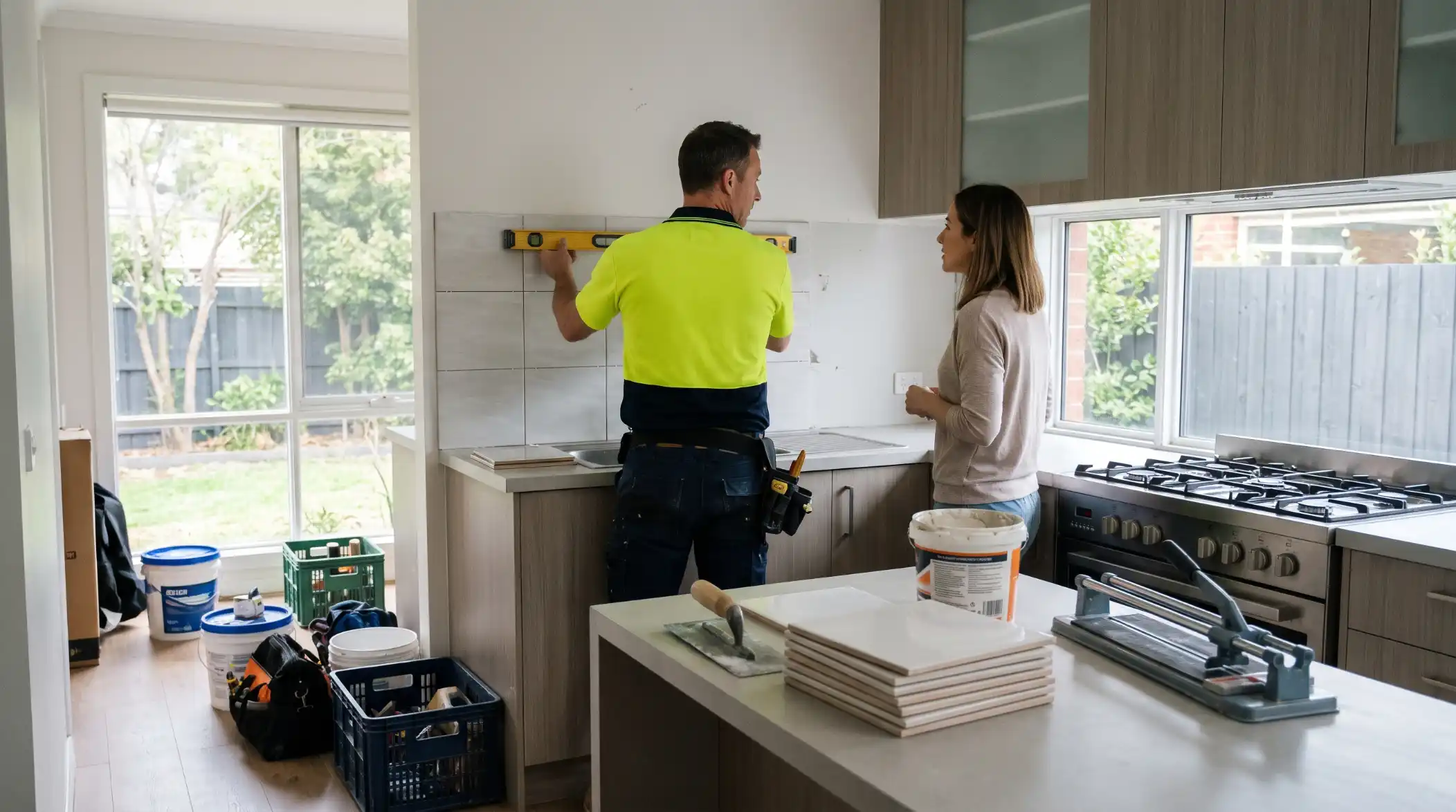
- The new level is no longer covered by doors.
- Accessible thresholds and surrounding floors that result in a step.
- Wall and closet clearances (built-in to fit a specific dimension), and
- Broad or under-cut toe-kicks and skirting that look set off in the cabinet, or have part missing
- Floor wastes that end up higher than the surrounding tiles, so water won’t drain
Imagine a tight little galley kitchen in a 60’s brick house in Dandenong. The dishwasher is already snugly nestled under the benchtop. Raising the floor by 12 mm could be more complex, as it might not come back into place without taking one or two feet off or getting inside the cabinet. A tiler, who works alongside a cabinet maker, finds out that the tiles aren’t put down after the cabinet, but before.
It’s the same with splashbacks. Tiling over already tiled wall tiles will cause the surface to bulge out a little bit, and will influence power points, window reveals and the area over the benchtop. You also need to consider how the color of your tiles will complement their cabinetry. We’ve covered that in our guide to color matching your tile to your cabinet finish.
Melbourne Conditions That Affect Your Decision
Older homes. Victorian and Edwardian houses frequently have wooden floors that bend. Tiles require a stable floor, adequate allowances for movement, and adding tiles over existing older cracked ones rarely works out.
Concrete slabs. At the other end of the scene are many post-war houses in south-east Melbourne, such as suburbs like Doveton and Dandenong, all built over slabs. Slabs tend to be stable, but any ‘patchy’ areas, as well as older adhesive, need a professional check.
Moisture. In sinks, dishwashers, and showers, water damage and staining are often concealed. Nearly any cabinet in the kitchen that has expanded should be investigated by first looking behind the wall. Of our posts about kitchen cabinets, our post on water-damaged kitchen cabinets gives the warning signs.
Old houses containing asbestos. Asbestos may be present in some old adhesives, underlays, or wall sheeting in houses constructed before the late 1980s. Do not grind, sand, or drill suspicious material without knowing a reputable company to do so. When in doubt, have it tested before work is underway! In some instances, it may be safer to leave old tiles where they are and then tile over them; however, this is a determination that must be made by a qualified person, and the tile surfaces should be tested first.
The decision of tile removal or tiling over existing tiles is made according to the cost.
There will be a wide range of tile removal prices. It is based on the type of tile, adhesive used, whether it is a timber or concrete base, access, and disposal. Generally speaking, the Melbourne removal price range is around $30 to $80 per sqm prior to any work carried out to the surface underneath. Use that as a starting point, and not a quote.
Removal may be a possibility that will reduce the initial cost, but not necessarily. When redoing for hidden damage, you will cost yourself on both counts.
| Factor | Tile over tile | Remove first |
|---|---|---|
| Preparation | Cleaning, priming, leveling | Demolition, scraping, repairing surfaces |
| Mess and disruption | Any mess and disruptions will be lower. | Higher (dust, debris, skip bin) |
| Height build-up | 10-15 mm | Minimal |
| Waterproofing | Can’t be inspected or redone | Can be inspected and redone properly |
| Hidden problems | All problems shall remain hidden | Found and rectified |
| Upfront cost | Installation cost tends to be less expensive | Quite expensive most of the time |
| Best suited to | Sound tiles in dry areas | Wet areas, damaged or hollow tiles |
Mistakes to Avoid
These are frequently encountered with tile over tile jobs. Our article on common tiling mistakes Melbourne homeowners should avoid goes into more detail, but the following are common when tiling over tile:
- To forgo tap testing and loose tiles.
- Error in tiling over top of shower floor without viewing the existing waterproofing layer.
- Installation on glazed, non-porous tile surfaces, using standard adhesive
- In regard to the vertical space added to doors, appliances, and cabinet toe-kicks, the extra dimension is ignored.
- It is impermissible to fill in cracks with grout that are truly movement.
- Selecting a tile system as an easy fix on the floor that doesn’t require the removal of the old tile.